
What Home Inspections Miss in Older Bay Area Houses
Reading time: about 6 minutes
TLDR
- A home inspection is usually required for a sale, but it often does not catch half of what is there, especially rot and water intrusion behind stucco.
- Damage tends to start where interior and exterior meet: decks, roof decks, guardrail posts, ledgers and windows.
- A small leak can run for years without showing inside, but leave enough moisture to grow fungus. If wood is wet and cannot dry, it is going to rot.
- On a complex, higher-end property, a waterproofing consultant's plan gives you a fix and a record you can hand to the next owner.
Because of the materials older Bay Area buildings are made of, there are limits to what they are capable of. Practices and materials were not always right at the time, and even when they were, decades of time and earthquakes take their toll. Stuff moves, cracks open, and water gets in. Pipes leak and roofs leak. People also have different tolerances for what they are willing to accept, and some owners, landlords in particular, will let a roof leak for years and years and just let it go.
Where the problems come from
In our experience, it shows up most in a house that was owned by an older couple who were not doing regular maintenance. The house then gets passed on through inheritance, or sold within the family.
There is also a lot of turnover in property in the Bay Area. With property values where they are, it often makes sense for owners to sell. A new owner buys a house and, a couple of years in, finds problems they are now on the hook for, problems they inherited and did not know about. Work done on a house just before a sale can be part of the cause. If it was done to make the house look nicer for the sale rather than done properly, it can create the conditions for a problem that presents itself four or seven years down the line.
On one job in El Cerrito, the owners had inherited the house from their parents, and no maintenance had been done for 15 years or more. Water had been getting in around a window at the front of the house, where the concrete stairs met the front wall, and running down the framing on the inside. The framing under the stairs and under the window was gone. You could pull it out with your hand.
What an inspection does not catch
A home inspection is usually a requirement for a sale to happen. But a lot of the time, inspections do not catch half of what is there. Rot and water intrusion are hard to see, and stucco in particular makes them invisible. There is no way you can tell from the outside.
Wood siding is easier to read. There are telltale signs: nails that have popped, and sometimes siding that has rotted away or warped because water is getting in behind it. With stucco, there is nothing to see until the stucco comes off.
Where water gets in
Some of the most problematic details are where exterior and interior spaces meet: the transitions between living space and decks, balconies, roof decks and the facade.
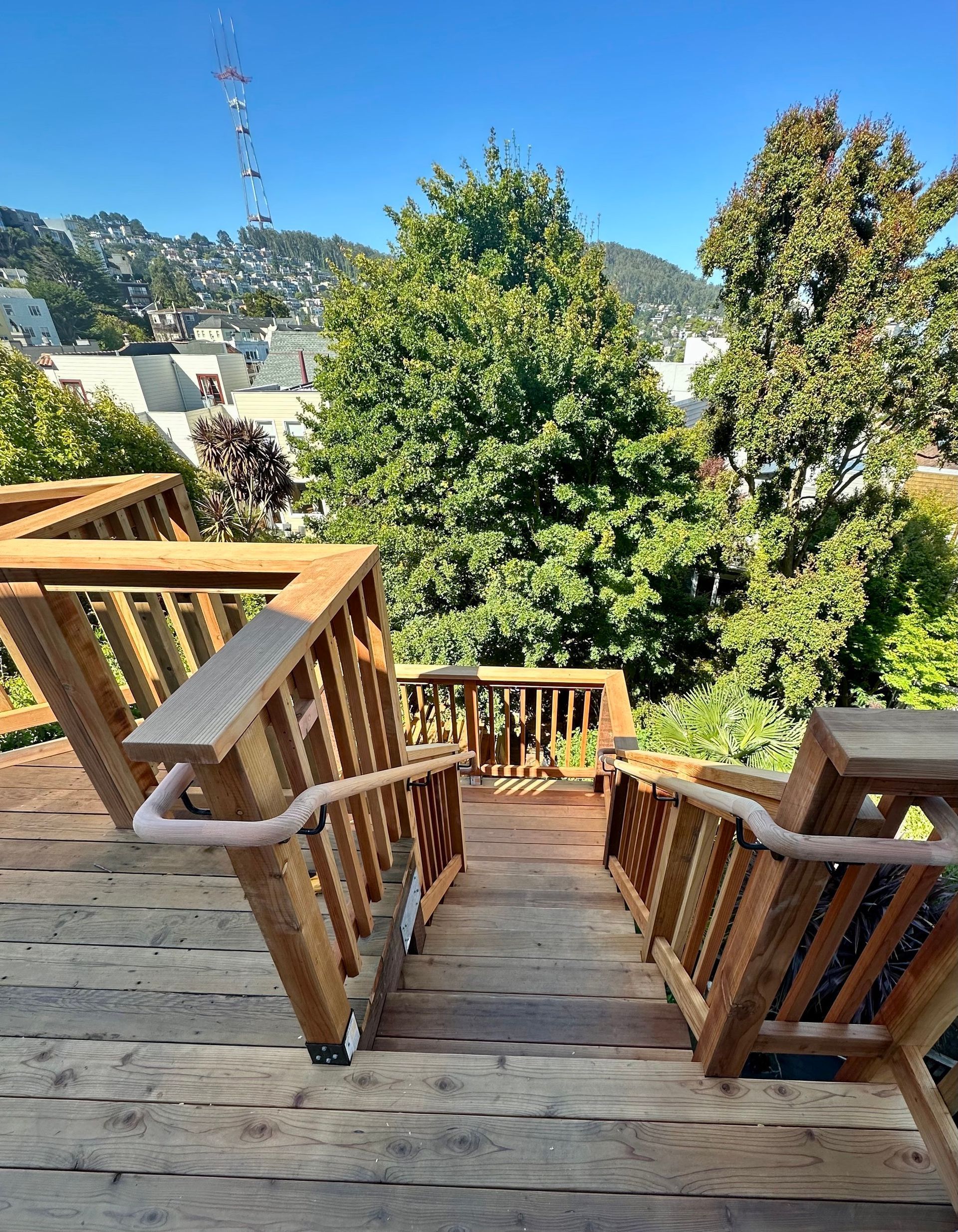
A roof deck with living space below it is a common source of trouble, especially where there are surface drains, or penetrations through the roofing layup. Handrails and guardrails are often attached with posts screwed or drilled down into the framing through the roofing substrate, and sealed with caulking or silicone. Over time the sealant shrinks and cracks, and water gets in.
Deck ledgers are another. The older way of attaching a ledger was to screw it straight onto the siding, with no spacers. There is no room for water to pass down behind it, so water gets trapped, there is no airflow, and the wood stays damp.
A small leak often does not present inside the house at all. It can seep down through the framing for years, never enough to show, but always enough to keep the wood wet and promote fungal growth. Then one day enough happens that it starts to present inside, the walls get opened up, and the damage is far larger than anyone expected.
A good rule of thumb: if there is water there and it cannot dry, it is going to rot. Rot then attracts termites, and once framing goes soft, the loads stop carrying, the stucco and plaster crack, and the house starts to settle and shift.
It is not only a structural problem
Moisture behind the walls can also mean mold, and black mold is particularly bad for people. Renters are especially exposed, because they are often in older buildings where mold can be in the finishes, behind the walls or in ductwork that picks it up, and they just do not know it is there. There are remediation companies that will come in and take samples of the air and of the walls to see what is growing.
A wall with nothing inside it
On a foundation job in Piedmont, we were working for another general contractor who held the full remodel contract. The exterior stairs at the front ran beside a wall that did double duty as a guardrail and a stair wall, with sheetrock inside and stucco outside. There was no way to see what was going on inside it.
Reframing the garage opening meant taking down some of the sheetrock in the garage, and when we did, we could look into where the framing for that exterior wall should have been. There was no framing at all. Termites and rot had completely destroyed everything inside the wall, the framing, the sheathing and the paper, leaving a hollow shell of stucco. Johnny had not seen one as bad as that before.
What happens when a remodel uncovers damage
When something like that is uncovered in the middle of a project, the first step is to open up enough to see how bad and how extensive the damage is. From there, the homeowners get a more comprehensive estimate, and they can say yes, say no and leave it for another time, or get someone else to bid on it.
When there is already a larger permit for the project, there is often room for the repair to be captured under it, as long as everyone is transparent with the inspectors. On the Piedmont job, the stucco at the front was already coming off to reframe the garage opening, so extending the work to the stair wall was not a big ask.
Doing the work at that point is usually in the owner's interest. The crew is already on the ground, the building department is already involved, the permit can capture the work, and the stucco subcontractor is coming through afterward anyway. Clients are understandably frustrated to find more work and more cost, but in the end they usually go ahead, because the house is already open. On the Piedmont job, the repair was outside our structural scope, so the general contractor on the project took it on.
When to bring in a waterproofing consultant
On a higher-end property with complex waterproofing transitions, such as exterior decking, handrails, balcony and deck attachments, and a history of leaks or poor installation, some owners hire a waterproofing consultant. The consultant assesses the existing conditions and puts together a plan that addresses every exterior waterproofing detail, with the products best suited to each one. The contractor then executes those details to the letter, in communication with the consultant.
It can be expensive. Consultants want the best products and the best details, and that costs money. But for an owner who has already paid for a lot of remediation, and does not want to pay for it again, the plan does two things. It fixes the problem properly, and it gives them a fully detailed record to keep on file. When the time comes to sell, they can show the next owner what was done, who planned it, which products were used and who carried it out.
We have worked with waterproofing consultants in the past. Between that and our own remediation work, we have a good understanding of where systems fail, which red flags to look out for, and the best practices for new installations at the points where exterior meets interior.