
What Makes a Shower Last: Waterproofing, Tile and Glass
Reading time: about 8 minutes
TLDR
- The critical parts of a bathroom are the waterproofing, the tile and the glass. Get those right and the room will look good.
- Every shower pan is tested and signed off by the city before any tile goes on.
- Tile is where the budget range is widest, and the quality of the installation is what you see every day.
- The glass, the blocking behind it and small details like the drain and the niche are settled before the walls are closed.
For us, the critical part of a bathroom is the tile: the selection of the tile and the execution of the tile. Then the waterproofing, and then the glass. Get those things right, pick nice fixtures, be mindful about the finishes you are using, and the room is going to look good.
The waterproofing has to be done properly, but what you are going to see every day is the tile and how it was installed: grout lines that are clean and uniform, the same depth and the same thickness throughout, and a layout that has symmetry even in an unusual room, rather than a big cut piece of tile stuck in a corner someplace.
The waterproofing sequence
The order of work in a shower is what makes it last. Our tiler comes out first and does the waterproofing. The pan is then inspected, and the city has to come out and sign off on it to make sure everything is waterproof. Only after the city signs off does the tiler come back, install the tile and grout it. The plumbers then come back and trim out the shower, and once the tile is in, the glass company comes out to take measurements and template the glass.
Liquid-applied waterproofing products are now the go-to. Very few clients are looking for PVC pans anymore. A liquid-applied membrane is a better product. It can stretch to accommodate seismic activity, and as a result we do not typically see failing waterproofing in modern shower retrofits unless the installation was poorly done.
The tiler we use prides himself on his waterproofing. In the eight or nine years Johnny has been using him, there has never been a callback.
Behind the tile
The walls in a bathroom get mold-resistant sheetrock, fixed with galvanized fasteners. Behind the tile goes an underlayment: DensShield is the typical one, with cement board or Hardie board as the alternatives, and Schluter now has a lot of products for underlayment as well.
Floors in older buildings need more attention than walls. If you have older timber floors, cracked concrete, or a retrofit into a building where something is not quite right with the foundation, an anti-fracture membrane goes down underneath the tile. It gives the floor more strength, so that new tile does not crack even if you get some seismic activity and some shakes.
Showers
A curbless shower , also called a wet room or an accessible shower, is one of the most common requests we see. The floor comes in and transitions straight into the shower, with no curb to step over, so someone older or with mobility issues can walk or roll straight in. The framing has to be set up to accommodate the slope, because the fall toward the drain starts beyond the envelope of the shower itself.
Linear drains have become more popular in showers too. Instead of a small 6-inch round drain that all the water flows to, a linear drain runs about 2 inches wide by 36 inches long, or whatever the width of the enclosure is, set flush with the tile. A tile-in version has a small tray that the tiler fills with tile to match the floor, so all you see is a reveal of about 1/8 of an inch around the drain, enough for the water to flow without affecting the look of the tile.
Steam showers need an enclosure that holds steam, and often a transom window above the door that can be opened to let some of the steam out when it gets too hot.
Some clients have asked for a window in the shower. We recommend avoiding one if it can be avoided, but sometimes it is the only option. In that case we recommend a vinyl window, because the water and the amount of moisture in the air will cause warping over time, even with an aluminum-clad unit with a wooden trim on the interior. The window also needs a proper waterproofed pan around it on the interior, and a slope away from it.
Fans with humidistats are required by code in every bathroom with a shower or bath. The humidistat senses humidity and kicks the fan on once it passes a set percentage, which stops condensation building up on the walls and the mold that follows. The fan has to be ducted to the exterior, at least 3 feet clear of any window or door.
Choosing tile
San Francisco and the East Bay are full of design showrooms that show different formats of tile and the range of what you can spend. You can go with budget off-the-shelf tile that is supplied locally or nationally, or with more premium products that are bespoke, handcrafted or small batch, some of them coming from Italy. Fireclay in San Francisco is a good resource for more individual tile selections.
Formats move in and out of fashion. A long 3x6 tile has become very popular for showers and shower enclosures. On a bathroom remodel and bedroom addition in Oakland for an architect, Jeffrey LaBoskey, a green long-format tile on the walls turned out really nice where it met the niche.
A niche is a little inset in the shower wall, waterproofed and tiled out, where you can keep body wash and the like. Some people like to put an accent tile in the niche to break up the wall, such as a penny round or a small hex pattern, and make a feature piece out of it. When there is a stone shelf or bench in the niche, we can use the same stone for the vanity, so the two connect visually.
At the other end of the scale, large-format porcelain slabs now come in 4 by 8 foot sheets, and even 4 by 10 and 4 by 12, and can face a whole shower enclosure. Installing them is a specialized process, but most of the stone installers and stone fabricators will take it on.
On grout, our advice is always the same: use a darker grout where possible, especially on floors and in showers. Light grout gets grubby, and scrubbing grout is no fun. A darker grout, even charcoal, makes the shower easier to maintain. With a white tile you can do a dark grout as a contrast.
Tile can be a large part of the budget. On a recent steam shower in San Francisco, half the cost of the project was the tile work.
Glass
For shower doors, partitions and sliding doors, we usually work with Acacia Glass Company, a long-established company with a shop on Geary in San Francisco that does a lot of high-end work. Thomas Kenihan, the owner, is very good at talking clients through their options: the finishes on the hardware, the hinges, the mounting brackets, and the transoms on steam rooms. He talks through what type of glass, what layout, how many panels and where the anchor points go.
There is a choice in the glass itself. Thicker glass can take on a green hue. A different glass, sold as sapphire, has a slightly different makeup that takes the green out and stays clear at thickness. It costs more, but it is worth considering when a bathroom has a lot of natural light through skylights or windows, or when designers have worked out specific colors and tones in the tile.
Tempered glass is required for any shower enclosure. There is also an easy-clean coating that can be applied at the factory, which makes the glass easier to wipe down after installation. It is an extra cost, but a good addition.
Before any of that, we put solid blocking all the way around the enclosure where we know there will be glass, so the glass company has the option to put anchors or screws wherever they need them. It is an easy fix for us at the start.
Vanities, lighting and the smaller details
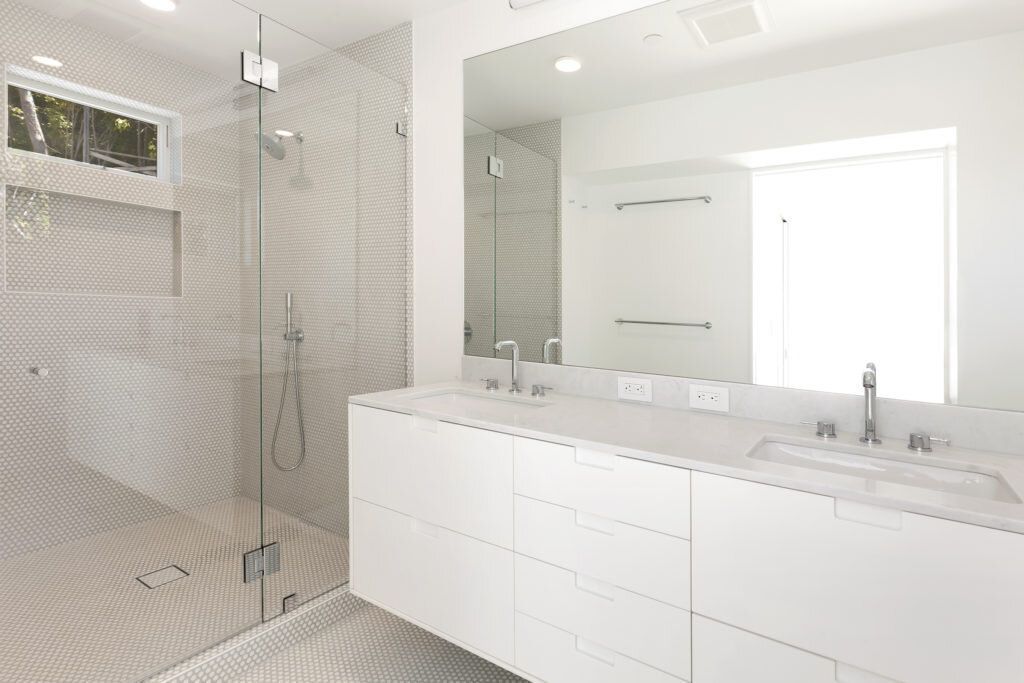
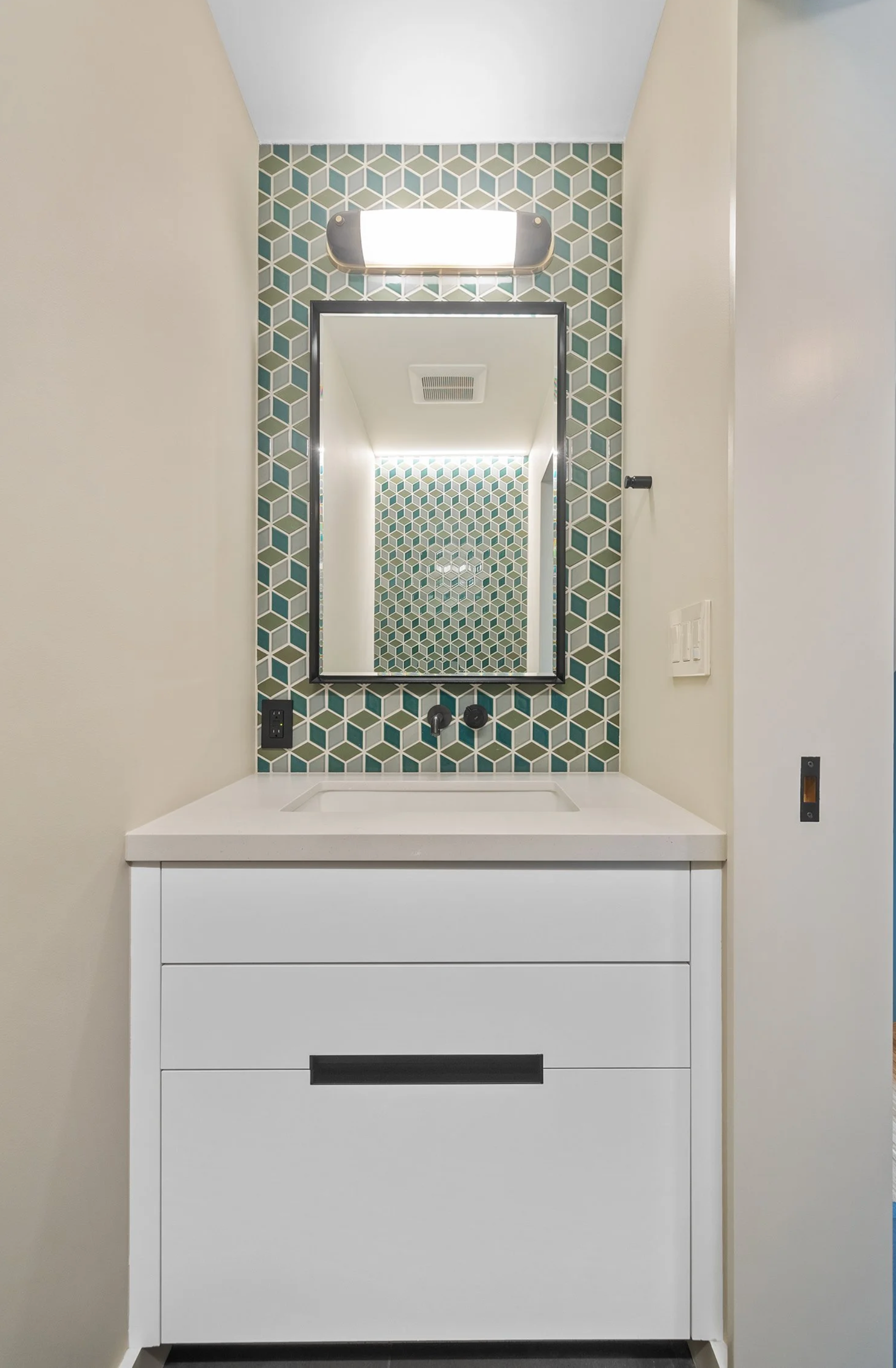
A floating vanity, mounted to the wall with space underneath, is a more modern look that a lot of people like, and it lets the tile run all the way through. We can also frame out the wall for an inset vanity, so the mirror finish is flush or almost flush with the wall. The mirror opens to shelves and electrical outlets, so an electric toothbrush can charge inside with the door closed and everything looks clean.
Bathrooms are often tight. Where there is space for one, a pocket door avoids the conflict between a door swinging into the room and the shower door, the toilet or the vanity. In a small bathroom, mirrors placed properly make the space seem bigger.
Lighting is where you can get creative, with low-voltage options over the vanity and mirror. On Surrey Street in San Francisco, the designer called for a mud-in LED strip in the shower ceiling, an inch or an inch and a quarter wide, set flush with the drywall. It shines straight down onto the tile and creates light and shadow across it, which really makes the tile stand out.
Underfloor heating is a low-voltage electric mat that runs off a transformer and goes down on the floor before the cement underlayment and the tile. You can be specific about where it goes. There is little point putting it in the shower, where hot water is already running, but in front of the toilet and across the main floor it means walking from a warm wooden floor in the bedroom onto a warm tile floor rather than a cold one. It is a bit of a luxury, but not a huge addition to the cost, and it is especially nice in a colder house without good heating.
For fixtures, the client chooses a finish, such as bronze, satin nickel or chrome. Satin or brushed nickel is the one we see most often.
Coordination is the rest of the job
A lot of a good bathroom comes down to coordination between the trades. With a wall-mounted fixture, the plumber and the tiler have to be coordinated precisely. If there are outlets or lights, and space is tight above a vanity or around wainscoting, the electrician has to be in on it too. The layout has to be right before anything is closed up.
You can go as elaborate or as simple as you like. If you bring in a designer, they can push the tile options, the colors on the walls and the finishes as far as the project allows. Either way, the tile, the waterproofing and the glass are what decide whether the room works.
I worked with Johnny on a few different projects around our house, including work that required drywall repair, tile work, roofing repair, downspout install, etc. What I appreciate about Johnny is that he's a problem solver, who will listen to your ideas while also recommending other options that may be a better fit for what you really want. The team he works with also seems highly skilled, and the tile work that was done on one of our projects was excellent.
Jay Beerman, Partnership Lead at Google