
Waterproofing an Exterior Stair, and What Happens When It Fails
Reading time: about 6 minutes
TLDR
- Exterior stairs fail at the junction where they meet the building, and the damage is rarely where the water got in.
- As redwood decays it loses the resistance that kept termites out, so a moisture problem becomes an insect problem.
- Older assemblies used tar paper, which becomes brittle and cracks under movement and load.
- We rebuild with liquid-applied membranes and pressure-treated framing.
Exterior stairs come up more than almost any other single piece of work we do. Old stairs give up because the framing is too old and rots away.
Why stairs specifically
An exterior stair is a horizontal surface attached to a vertical wall. That junction, where the stair structure meets the building, is one of the most demanding waterproofing details on a house, and it is under constant load from both water and movement.
On a hillside property in Oakland or a Victorian in San Francisco, the stair is often the main access to the house rather than a garden feature. When it fails, it has to be dealt with.
How wood actually fails
Older Bay Area houses were framed in redwood and Douglas fir rather than pressure-treated lumber. Redwood in particular contains tannins and resins that resist fungus and insects, which is exactly why it was used so widely for decking and exterior framing.
Water changes that. When wood stays wet in a space with no ventilation and no opportunity to dry, fungus begins to grow. Microorganisms break down the cellulose fiber in the timber and the wood starts to decompose, which is a natural process rather than a defect.
As the wood decays, the natural resistance in redwood dissipates. The tannins and resins that made it unattractive to termites stop doing that job, and the softened wood becomes actively attractive to insects in a way that sound redwood is not. What began as a moisture problem becomes a termite problem.
At that point the framing stops carrying load. Members go soft, load paths that existed on the original drawings stop existing in the building, and the movement shows up elsewhere: cracks in stucco, cracks in lath and plaster, floors and openings that have shifted out of true.
The damage is rarely where the water got in
Water travels. A leak at the top of a stair, or at a roof junction above it, can run down inside a wall and do its damage several feet from where it entered. Travelling water is why a stair that looks sound from the outside can be structurally gone underneath, and why the first visible symptom is often something apparently unrelated, such as a crack in the stucco.
Ventilation is the other half of the problem. Wood that gets wet and then dries is fine. Wood that gets wet in an enclosed space with no airflow stays wet, and staying wet is what starts the process. A great many failed stairs are the result of an assembly that was closed up tight with no way for moisture to leave once it found a way in.
Why the older assemblies fail
The reason these stairs failed is usually not poor workmanship. The cause is almost always that they were built with the materials available at the time.
Under a set of concrete stairs, or behind stucco, the waterproofing barrier was commonly two-ply felt : a tar paper lapped and overlapped to shed water to create something approaching an impermeable layer.
Over decades it becomes brittle. Meanwhile the framing beneath it softens, the weight of the concrete above presses down on framing that is no longer holding its shape, and the paper is stretched. Paper does not stretch. The paper cracks.
Add a seismic region to that. Brittle paper with concrete sitting on top of it does not survive movement well. Once there is a crack, water gets in, and the process that softened the framing accelerates.
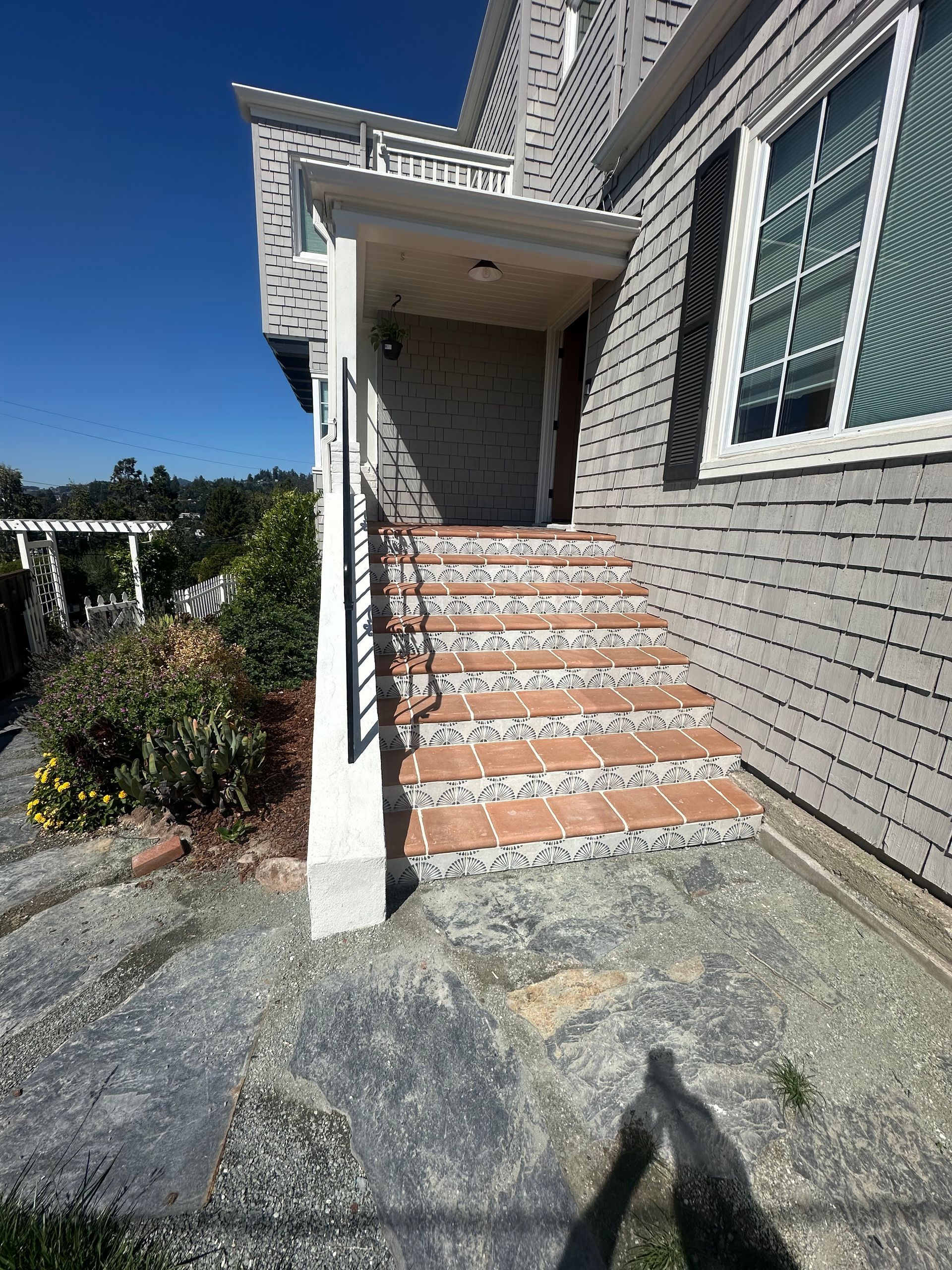
Johnny and crew rebuilt our front stair (which were falling down.) Excellent craftsmanship and quality. The attention to detail is amazing. Johnny is always communicative and helpful.
Jake P.
What a proper rebuild involves
The first step is finding out how bad it is, which means taking the finishes off. Stucco, siding, drywall or lath and plaster all come off until the framing and the sheathing are visible and the scope is real rather than estimated.
When the picture is not clear at the outset, we work on a time and materials basis with a budget outline and agreed contingencies, so you know what is covered and at what point we come back to you.
When existing framing has failed, shoring goes in first. Shoring is temporary structural support that picks up the loads the failed framing was carrying, which allows the rotted material to be removed safely and replaced to match the existing layout so that the finishes still land where they should.
Material choice
What goes back in depends on exposure.
Anywhere with a risk of damp or poor ventilation, anything on a horizontal exterior surface, and anything in contact with the ground gets pressure-treated lumber. Under a stair, that means pressure-treated sheathing where the stair meets the exterior facade, and pressure-treated framing for the stair itself.
Ordinary dry interior framing conditions, with habitable space inside and a regular wall assembly, get Douglas fir, which is standard framing material.
The waterproofing itself
We rebuild with liquid-applied membranes rather than lapped paper. Under stairs and on foundation walls we use TREMproof 250GC, applied directly onto the framing members so that it sheds water rather than relying on overlaps to do it. The membrane returns up the exterior facade over the sheathing by a minimum of 6 inches, and the new exterior barrier laps down over it.
When a client wants belt and suspenders, we also use a liquid-applied barrier on the exterior facade sheathing. PROSOCO R-Guard Cat 5 is the premium option here. What you get is a seamless elastomeric membrane rather than a lapped one, which means the performance no longer depends on getting every overlap and every flashing detail exactly right.
The material cost difference across the front of a house is on the order of a thousand dollars.
Permits
When the work is a genuine in-kind repair, replacing something that already exists with the same thing in the same place, a repair permit is usually available and moves faster than a full permit set. When a repair becomes a change, whether that is a different size opening, a different structural arrangement or additional square footage, the full route applies.
When a rebuild becomes an upgrade
A failed stair is often the moment a client decides to improve it rather than replace it like for like, since the demolition is happening either way.
On a Craftsman house in Piedmont with brick stairs suffering termite damage, we did the demolition and repair, rebuilt the structural ramp that carries a masonry stair, installed new waterproofing, and a stonemason set the new brick to a pattern the client chose. Stucco, paint and a sealer followed.
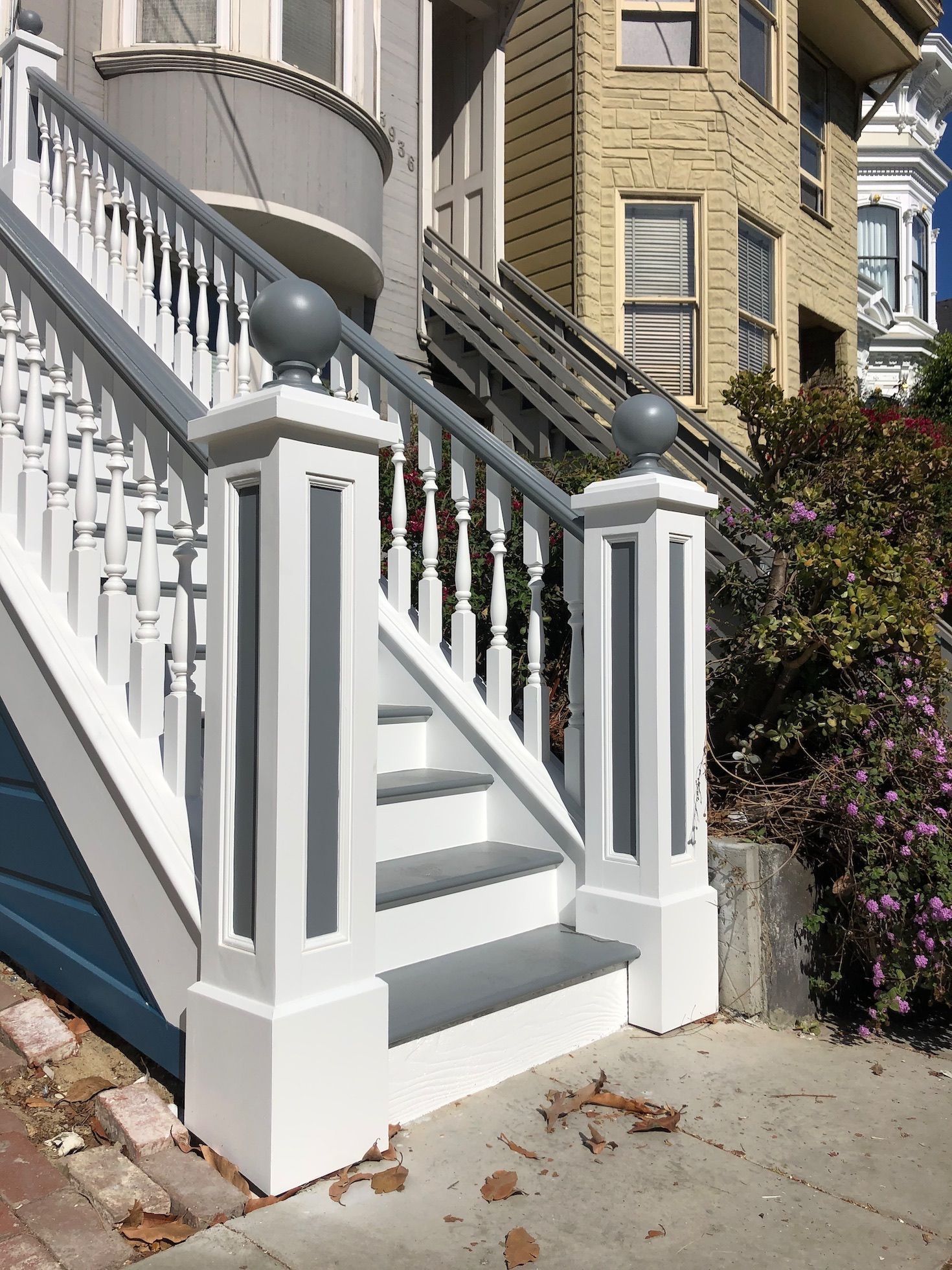
On a Victorian in the Mission District with a failed original stair, we rebuilt on pressure-treated framing with exterior grade cedar newel posts, MDO exterior grade plywood casing and 1x12 bullnosed laminated Alaskan yellow cedar treads. The rail cap is profile cedar made up from four separate parts, which lets the assembly be adjusted to the run of the stair. Profiles came from lumber stock, checked against what Beronio Lumber held, with the client approving the options before anything was milled.
Work on a San Francisco Victorian carries planning review as well, because the property is protected and the work has to be in keeping with the existing architecture.
Rebuilding in materials rated for the exposure they will actually get is the difference between a stair that lasts decades and one replaced twice in the same period. Where existing cedar can be saved we save it, and what cannot be reused is replaced through a certified sustainable supplier in Berkeley.